
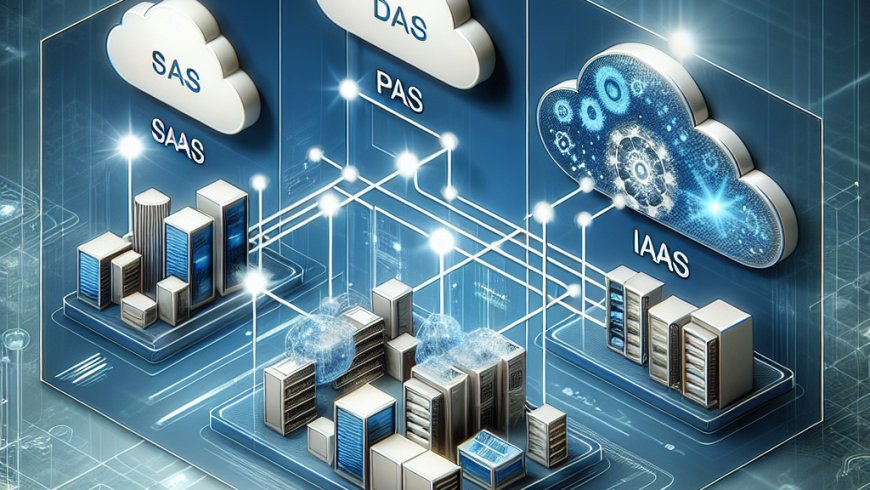
SaaS, PaaS, and IaaS are the three mainstream cloud service models, each offering flexible solutions for different needs. SaaS (Software as a Service) allows users to use applications without installation, suitable for focusing on business development; PaaS (Platform as a Service) provides development platforms, facilitating programming and deployment; IaaS (Infrastructure as a Service) flexibly supplies computing resources, ideal for enterprises requiring high customization.
Introduction to the Three Cloud Service Models
SaaS: The Convenience of Software as a Service
SaaS (Software as a Service) is the most user-friendly layer among the three cloud models. In the SaaS model, the software provider hosts the application in the cloud, and users access it via a browser or a lightweight App. This "subscription-based" service model eliminates the need for enterprises to build their own servers, develop programs, or handle software maintenance and security updates. Common SaaS examples include Google Workspace, Slack, and Salesforce. Its biggest advantages are extremely fast deployment, a low barrier to entry, and access from anywhere at any time, making it ideal for organizations needing instant messaging, project management, or customer relationship management.
PaaS: Flexibility and Scalability of Development Platforms
PaaS (Platform as a Service) primarily caters to software developers and IT teams. It provides a pre-configured cloud runtime environment and development tools, including operating systems, database management systems, and middleware. Developers can focus solely on writing code and deploying applications without spending time managing the underlying hardware infrastructure. Google App Engine, Heroku, and AWS Elastic Beanstalk are typical PaaS services. PaaS can significantly shorten development cycles, reduce maintenance difficulty, and features auto-scaling capabilities that automatically adjust computing resources based on traffic to ensure application stability under high loads.
Analysis of Target Audiences for the Three Cloud Services
IaaS: Control of Infrastructure as a Service
IaaS (Infrastructure as a Service) is the base layer of cloud computing, providing virtualized computing resources such as virtual machines (VMs), storage space, network firewalls, and load balancers. Users rent these hardware resources and have a high degree of control over them, deciding on the operating system, middleware, and which software to install. Common products include AWS EC2 and Google Compute Engine (GCE). IaaS is ideal for large enterprises, scientific research institutions, or units needing to run large, complex systems (such as self-built databases or big data processing platforms) that require highly customized environments, allowing them to enjoy cloud flexibility while retaining complete management control.
How Enterprises Choose the Right Cloud Service
Enterprises of different sizes and industries need to consider IT strength and operational goals when choosing among the three cloud services. Small and medium enterprises or startups usually prioritize SaaS because it allows for the most mature digital tools with minimal initial investment. For internet companies with R&D teams pursuing rapid product iterations, PaaS can significantly improve development efficiency. For industries like finance and manufacturing with deep IT maintenance experience and needs for underlying optimization or strict regulatory compliance, IaaS is the best choice for building hybrid or private cloud infrastructure. In practice, most modern enterprises use a mix of these three service models based on different business modules.
Cloud Service Pricing and Selection Advice
Analysis of Cloud Service Pricing Methods
The billing logic of cloud services is completely different from traditional buy-out hardware. SaaS usually adopts a "per user (seat)" or "tiered" subscription-based monthly or annual fee, offering the highest predictability. PaaS and IaaS mostly use a "pay-as-you-go" model, billing based on actual computing hours used (CPU/RAM), data transfer traffic (egress), and storage space. While this model achieves "pay for what you use," it also requires professional cloud cost management (FinOps) to avoid budget overruns. Understanding the billing details of different models helps enterprises achieve the best balance between budget control and technical expansion.
Cloud Service Selection and Optimization Suggestions
If an enterprise values "fast time-to-market" and "low maintenance burden," SaaS is absolutely the top choice; if it pursues "development agility" and "automatic resource elasticity," PaaS provides the best support; if it needs "maximum control" and "high environment customization," IaaS should be chosen. After selection, resource usage should be continuously monitored, and enterprises should utilize committed use discounts (CUD) or reserved instances (RI) provided by cloud providers to optimize costs. Furthermore, cybersecurity is a common topic for all cloud models; enterprises should clearly understand the "Shared Responsibility Model" with providers and implement internal permission management and data encryption to ensure the safety and benefit of cloud transformation.
Frequently Asked Questions FAQ
Q1: What are the main differences between SaaS, PaaS, and IaaS?
Simply put, the difference lies in the distribution of "management responsibility." In IaaS, you manage the OS, data, and applications; in PaaS, you only manage applications and data; in SaaS, the provider manages everything, and you are only responsible for "using" it. Moving from IaaS to SaaS, the management burden on the user decreases, but the flexibility for customization also decreases—a trade-off between control and convenience.
Q2: How should an enterprise evaluate which cloud model to migrate to?
Enterprises should first inventory their core competencies. If your competitive advantage lies in a specific business process (like sales), you can outsource non-core systems (like HR, CRM) to SaaS. If your advantage lies in self-developed software products, PaaS can help you focus on R&D. Only consider building the underlying environment on IaaS when existing SaaS or PaaS cannot meet specific performance optimizations or extreme security needs.
Q3: What are the traps to be aware of in cloud service pricing?
The most common traps are "Data Egress" fees and "Idle Resources." When large amounts of data are directed from the cloud to the external internet, traffic fees are often unexpectedly high. Additionally, IaaS instances or attached storage disks that have been created but not used will still be billed continuously. It is recommended to perform regular billing audits and set budget alerts to ensure cloud spending remains cost-effective for operations.


